What the Barrel Remembers: Secrets of Aging, Blending, and Tasting Barrel-Aged Beer — Part 1
The Fifth Brewing Element
I've had a fascination with oak barrels for many years. Working as a professional forester for more than 40 years, I've worked in white oak forests, bought and sold white oak logs that would be milled into staves used in making barrels. Then, as my interests grew to include beer, the marriage of beer and oak barrels took my fascination to an entirely new level.
This is a three-part series entitled What the Barrel Remembers: Secrets of Aging, Blending, and Tasting Barrel-Aged Beer. It grew from my enjoyment and curiosity about these extraordinary liquid creations.
In part one of this series, I talk with Mike Tonsmeire, co-founder of Sapwood Cellars in Columbia, Maryland.
Then, in part two, I share an exchange with Paul Davidson, brewer and co-founder of Elder Pine Brewing & Blending in Gaithersburg, Maryland.
And, in part three, we go for the practical application of barrel-aged beer with The Alchemy of Oak: Enjoying Barrel-Aged Beers, we get into the messages these master brewers share about how we should enjoy their barrel-aged creations.
The genesis of this journal series came when I was sitting at a barrel-aged beer tasting at Sapwood Cellars in early 2026. Mike Tonsmeire was our host and master of ceremonies. There were themed flights such as maple syrup influenced beers, vertical flights (same beer released over several years) and pairing these special beers with desserts.
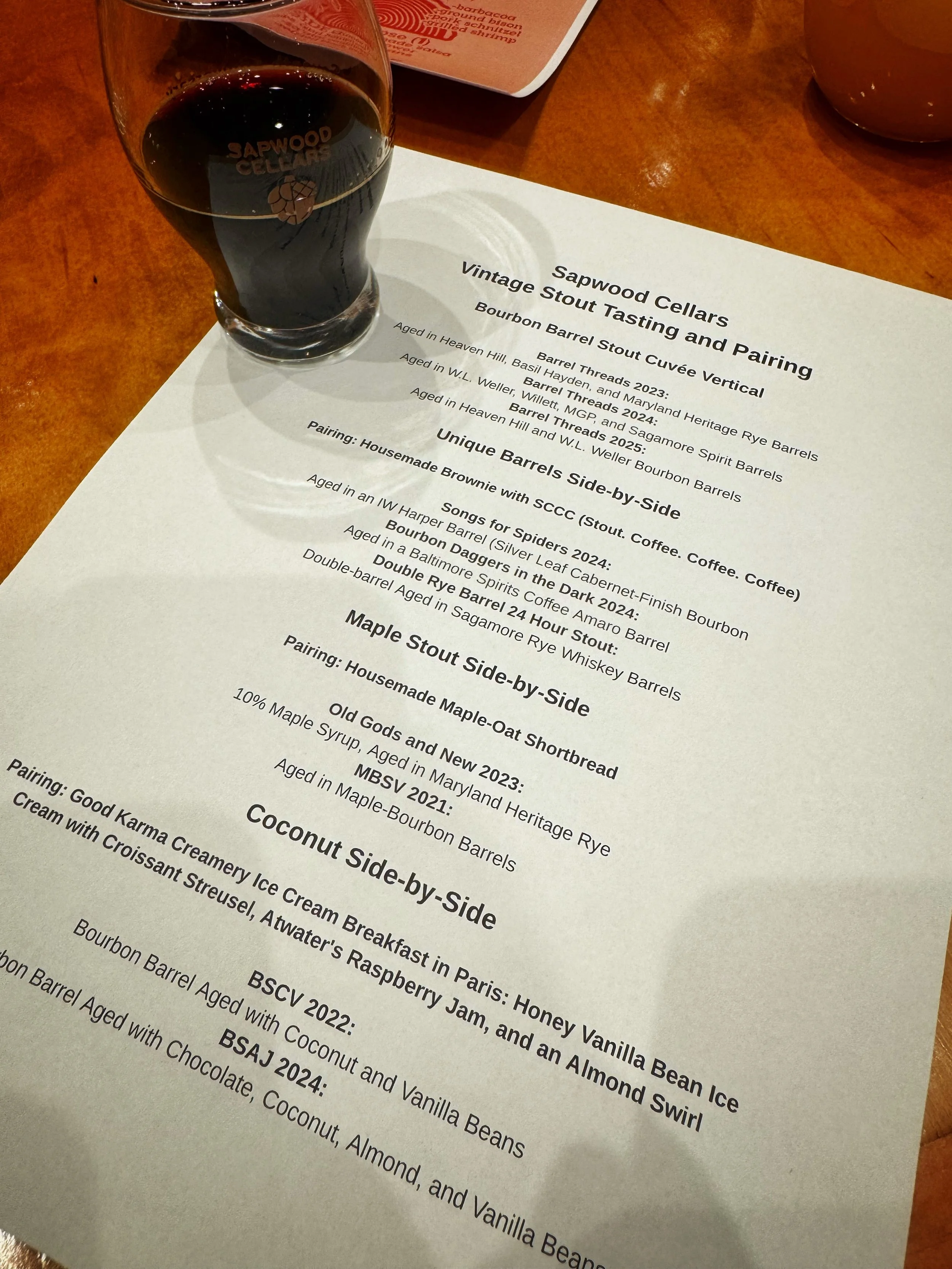
Sapwood Cellar’s Tasting menu
As I pondered what I was experiencing, questions kept popping into my mind, and Mike was generously answering questions coming from all over the room. And I thought, if I’d like a deeper understanding of these beers, then certainly there must be others who would like to know more as well. When the event ended, folks rushed to Mike to continue the questions and share their appreciation for the beers we had just tasted.
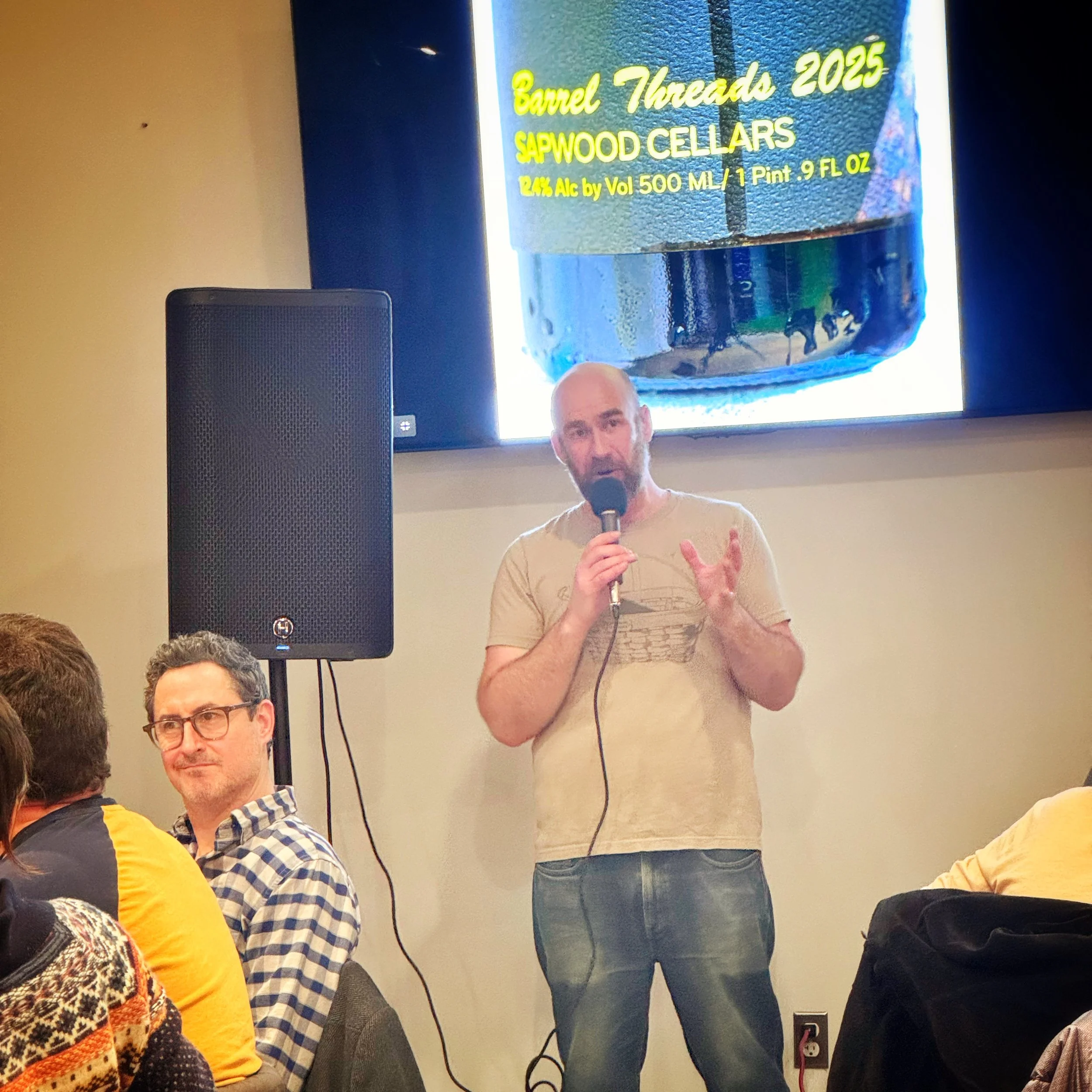
Mike Tonsmeire describing the Sapwood beers
When the group had dwindled to only a few, I asked Mike if he would be interested in talking with me about what would eventually become this article. Graciously, he agreed, and a few days later, we sat down, and Mike poured (literally and figuratively) out over the next two and a half hours.
Origins & Inspiration: A Journey into Wood
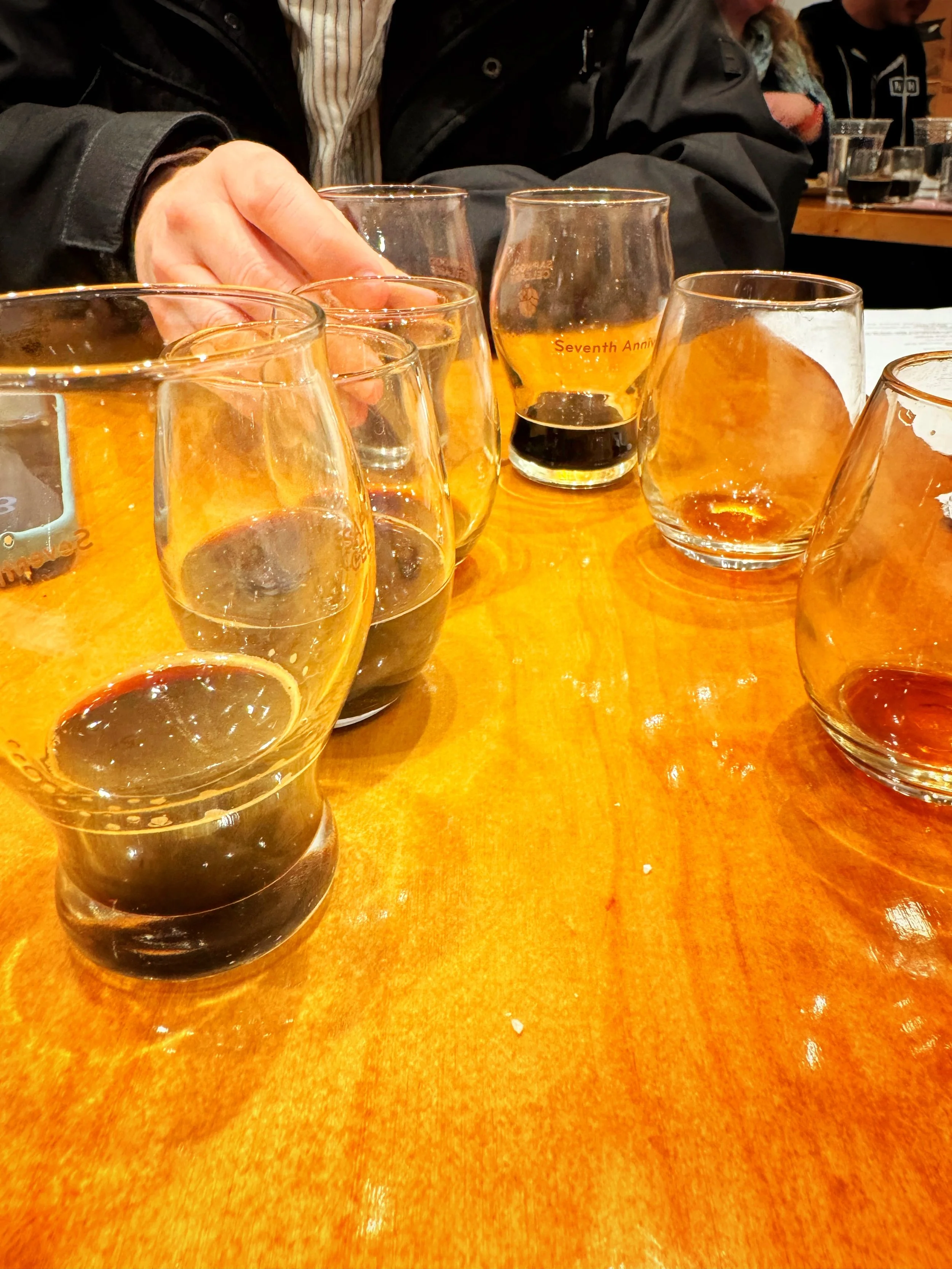
Vintage beer tasting remnants
Mike shared that he traces his journey into barrel-aged beers back to 2008. It began in a friend’s basement, a collaborative effort among home brewers to tackle the daunting size of 50- or 60-gallon barrels. “A 50 or 60-gallon barrel was too big for one home brewer,” he recalls, describing how they pooled resources, each contributing five gallons of beer to fill a single barrel. This early experimentation led to a Flanders Reds and a bourbon barrel-aged Wee Heavy, utilizing barrels from Virginia distilleries and local wineries.
This hands-on, collaborative approach laid the groundwork for Sapwood’s formal program. Tonsmeire’s pre-Sapwood experience included consulting for breweries like Modern Times, where he helped launch their barrel-aging program. It was there he learned a crucial lesson: “Barrel aging isn’t something that you can do from distance consulting. Barrel-aging is really about being there, tasting the barrels, thinking about the flavors, figuring out what ingredients you might want to add based on those flavors”. This philosophy of intimate involvement and continuous sensory evaluation became a cornerstone of his approach.
Tonsmeire draws inspiration from a pantheon of brewing legends. Ron Jeffries of Jolly Pumpkin Artisan Ales, a pioneer in American sour beers, profoundly influenced his early understanding of mixed-fermentation. Vinny Cilurzo of Russian River Brewing, known for his meticulously consistent sour program, also served as a mentor, though Tonsmeire notes their programs diverge in scope: “He has a much more limited number of beers that are super dialed in and super consistent and beautiful. But we probably put out more unique sour beers in a year than he has, period, as Russian River”. Other influences include Cory King from Side Project Brewing, Alan Sprints of Hair of the Dog, and collaborations with local peers like Nathan Zeender (former head brewer) of Right Proper, Tröegs, Cambridge Brewing, and Toppling Goliath. Early experiments, while sometimes yielding “awful” results, were invaluable for “dialing it in” and understanding the complex interplay of wood, beer, and microbes.
Sourcing the Wood: Barrels as Ingredients
For Tonsmeire, a barrel is far more than a mere container; it is a vital ingredient. The selection of barrels is a nuanced process, driven by both intention and opportunity. Bourbon barrels are a common entry point, with specific brands like Weller and Eagle Rare sought out for their distinct flavor profiles and name recognition. Beyond bourbon, Sapwood utilizes a diverse array of spirit barrels, including rye, rum, apple brandy from Laird & Company in New Jersey, and even gin barrels from local distiller McClintock Distilling, which Tonsmeire praises as “the best gin barrels we’ve ever gotten from anybody”. Wine barrels, particularly red wine barrels like those from Chrysalis Vineyards, are also employed, especially for sours. Virgin oak (not previously used to hold spirits), however, is generally avoided due to its expense and the rapid, overwhelming character it imparts to beer.
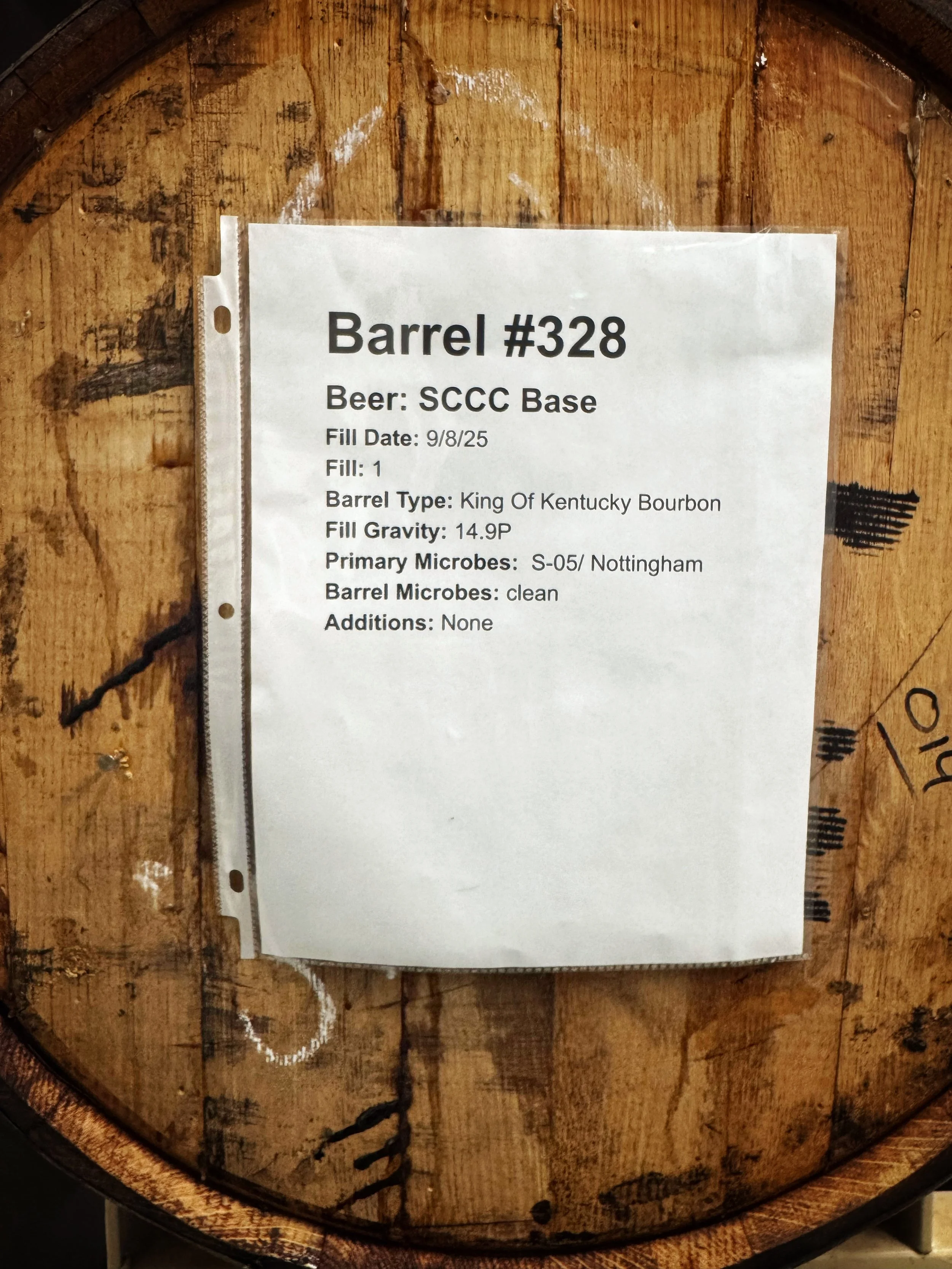
Aged beer barrel notes
The philosophy behind pairing a barrel with a beer is often a blend of strategic intent and adaptive response. Bourbon barrels are typically reserved for imperial stouts, imparting classic notes of caramel, vanilla, and chocolate.
Wine barrels are favored for saisons and sours, where their more subtle character can complement the beer’s acidity and funk. Sometimes, the pairing is opportunistic, as with an amber lager that found its way into a barrel simply because it wasn't selling quickly.
Sapwood’s barrel sourcing strategy prioritizes local relationships when possible, working with Maryland producers like Sagamore Spirits, McClintock Distilling, Old Westminster Winery, and Crow Vineyard & Winery. For other needs, they turn to barrel brokers like Northeast Barrel, Midwest Barrel, and The Barrel Broker, treating them as commodities to be purchased online. Tonsmeire notes the competition for high-demand barrels, with certain whiskey brands commanding a premium due to their reputation.
Preparing & Maintaining Barrels: The Foundation of Flavor
Upon arrival, barrels undergo a conditioning process to ensure their integrity and suitability for aging. This includes inspection for leaks, which can be addressed by swelling the wood with hot water. Wine barrels, unlike spirit barrels, often require sulfuring or rinsing to prevent vinegar formation .
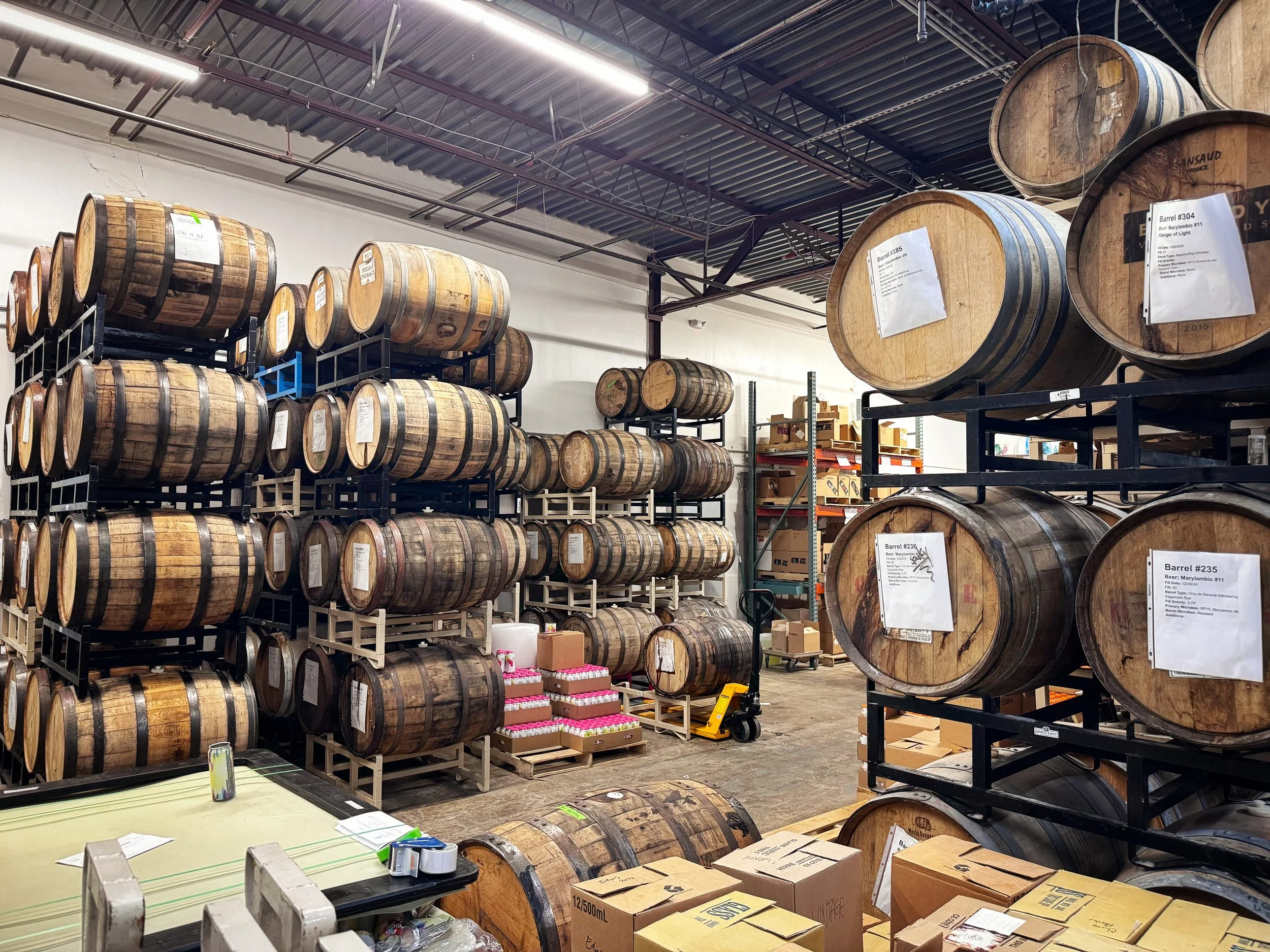
Sapwood Cellars barrel room
“each barrel that you reuse will have some of that culture you selected, but you can’t sanitize wood perfectly”
Barrel reuse is a key aspect of Sapwood’s sour program. While bourbon barrels are rarely reused for stouts—as the goal is to capture fresh "bourbon oomph" —sour barrels are frequently refilled. This practice allows the barrels to develop a unique “personality” over time, as residual microbes contribute to the evolving character of subsequent batches. Tonsmeire explains, “each barrel that you reuse will have some of that culture you selected, but you can’t sanitize wood perfectly… each one of the five barrels… is now in a barrel that has a little bit of its own direction”. This individuality is embraced, with certain barrels becoming known for their desirable contributions.
The Aging Process: A Dance with Microbes and Environment
The typical barrel aging workflow at Sapwood begins with designing a base beer recipe, sometimes specifically for barrel aging, other times adapting existing beers. After primary fermentation, the beer is transferred to barrels, where it undergoes maturation.
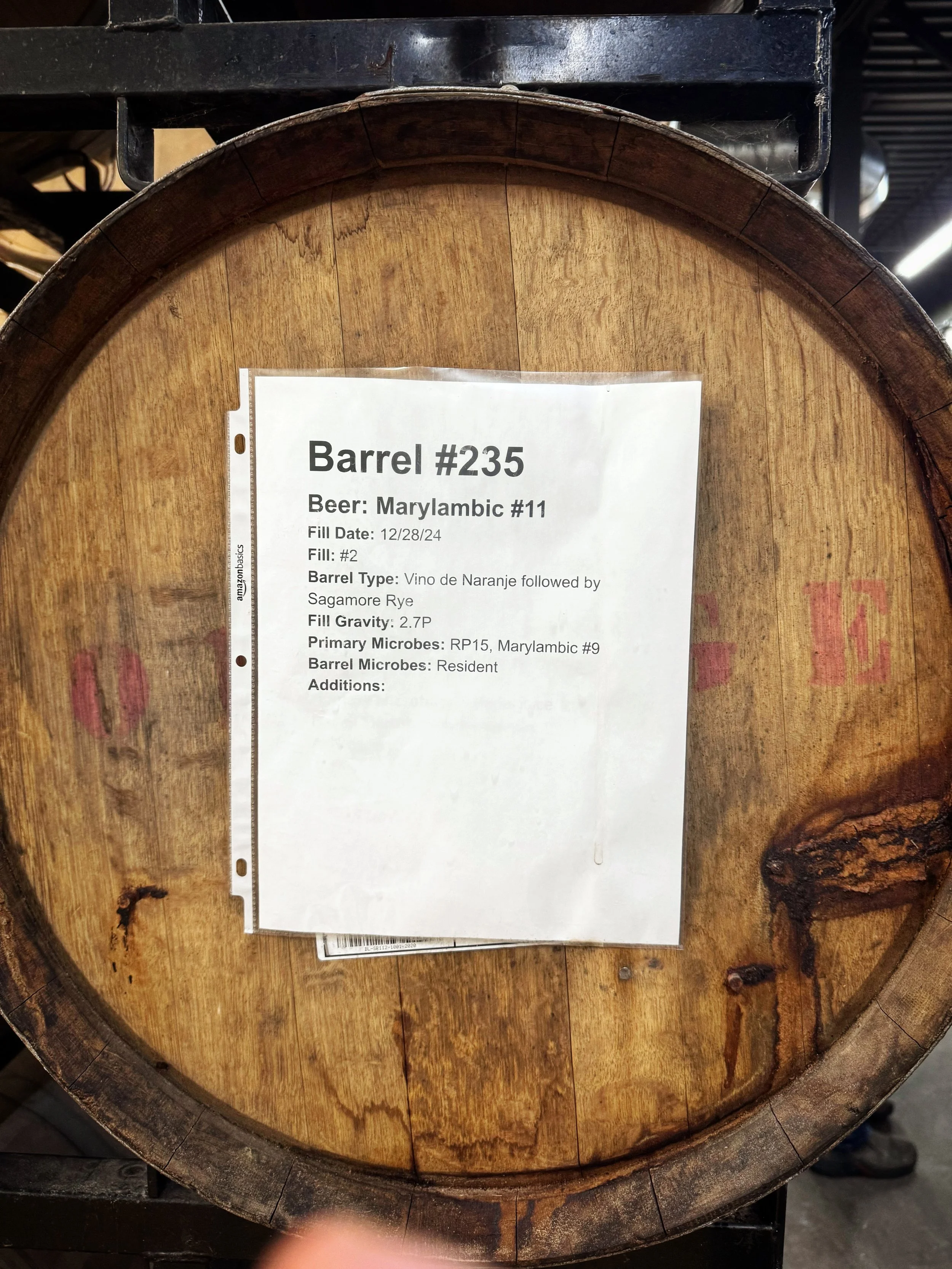
Marylambic barrel
Environmental control presents a significant challenge in Maryland’s climate. Sapwood’s barrel room lacks precise temperature and humidity control, experiencing cold winters and summers that can reach 80°F. This variability impacts the aging process and the rate of evaporation, or "angel's share." ("Angels' share" is a term for the portion (share) of a wine or distilled spirit's volume that is lost to evaporation during aging in oak barrels.)
Microbial management is central to the sour program. Tonsmeire actively cultivates a diverse "house culture" by sourcing microbes from various yeast labs, bottled dregs, and even wild captures. This intentional diversity ensures a range of flavors for blending. For clean beers, strict sanitation protocols are in place, including separate equipment and aggressive cleaning with hot water pasteurization to prevent unwanted microbial contamination.
Time, Testing & Uncertainty: The Brewer's Patience
Maturation periods vary significantly. Stouts typically age for 1 to 2 years, with Sapwood aiming for an average of 1.5 years. Sours, with their more complex microbial activity, can mature over 9 months to 3 years.
Monitoring the beer is a continuous process that involves regular sampling and tasting. Tonsmeire and his team frequently evaluate barrels to assess their progress and make blending decisions. This iterative process allows for adjustments and ensures the beer develops as intended.
Despite careful planning, barrel aging is inherently unpredictable. Issues like oxidation, over-oaking, or unwanted infections can arise. Tonsmeire emphasizes proactive measures to mitigate these risks, such as reducing oxygen contact during transfers and maintaining rigorous sanitation. If a barrel doesn't meet expectations, it might be blended with other barrels to salvage it, or, if truly problematic, simply dumped. “Barrels are cheap enough, it’s not worth trying to reset a barrel that didn’t make good beer already”.
Adjunct additions, such as vanilla, cacao, fruit, or coffee, are typically added post-aging to infusion tanks, allowing for precise control over flavor integration. This approach ensures the wood character is established before other flavors are introduced, preventing them from being overshadowed or altered by the aging process.
Determining Readiness: The Art of Blending
Determining when a barrel-aged beer is ready is a blend of sensory benchmarks, experience, and intuition. It’s about achieving optimal flavor integration, where the beer, wood, and any adjuncts harmonize. Tonsmeire describes the process as a painter at work, where different barrels represent different colors on a palette. Blending panels, involving key staff and trusted palates, play a crucial role in this decision-making, offering diverse perspectives to refine the final product.
Market Response & Consumer Trends: A Growing Appreciation
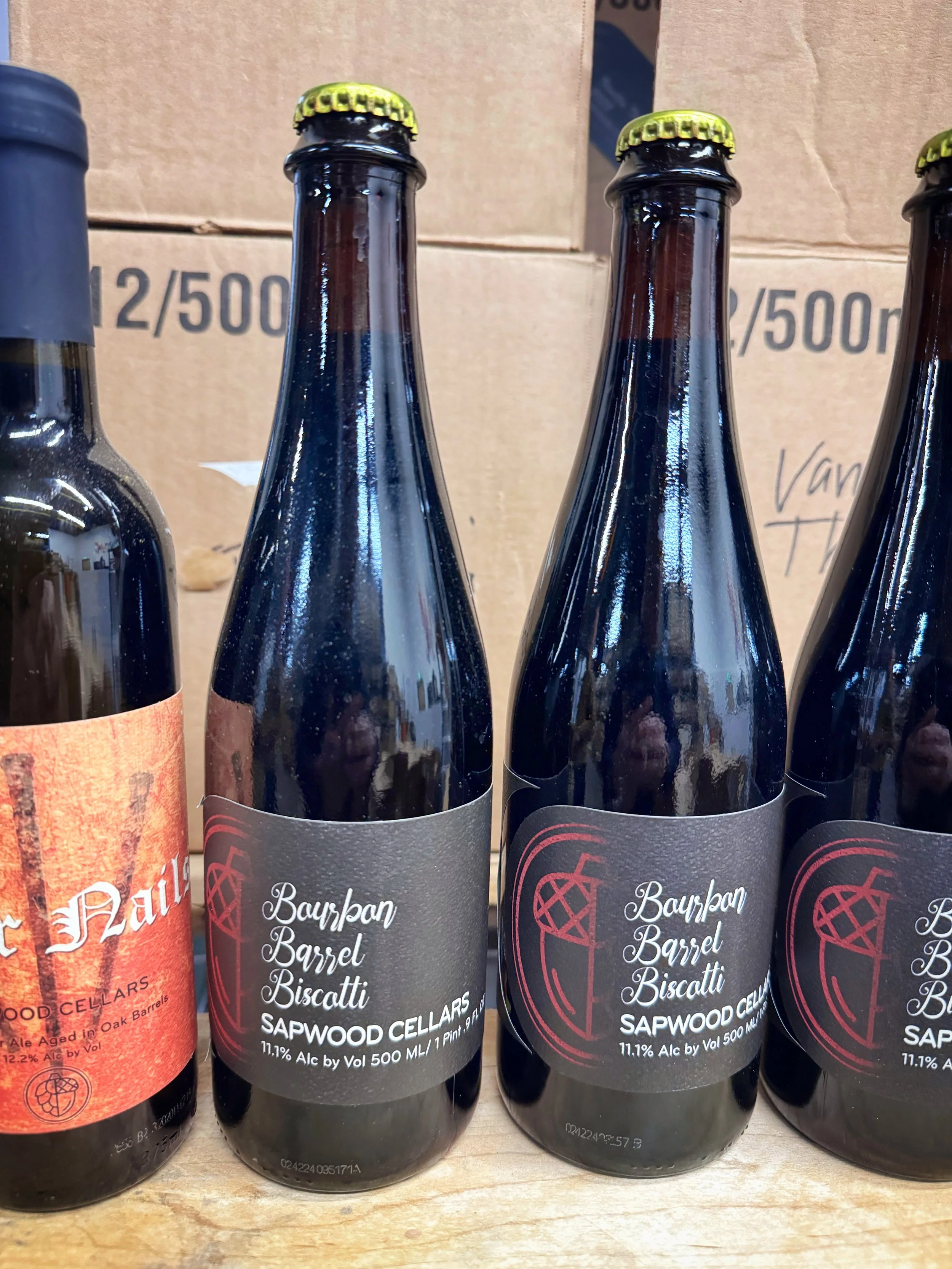
Bottled results awaiting
The popularity of barrel-aged beers has surged, with strong demand for imperial stouts and mixed-fermentation programs. Limited releases and bottle shares have cultivated a dedicated following. Sapwood’s club memberships for sours and stouts are highly successful, with the sour club surprisingly having more members, reflecting the niche but passionate market for well-executed wild ales.
In Maryland, local consumers have shown a strong appreciation for these complex beers. Tonsmeire notes that while barrel-aged beers command a premium, they also attract customers seeking unique, high-quality offerings. Events and festivals further amplify their impact, creating a vibrant community around these special releases.
Personal Favorites & Signature Releases: The Unexpected Delights
Tonsmeire’s favorite barrel-aged beers are often those that emerge from unexpected combinations. He recounts a "happy accident" where a Willett rye barrel, pre-flavored with Amburana wood spirals, yielded a character too good to be lost in a heavily adjunct-laden stout. This led to blending it with a sweet barleywine, creating a new, unplanned beer that became one of his favorites. This exemplifies the iterative, creative process at Sapwood.
Signature releases like BSCV (Bourbon Barrel Aged Coconut Vanilla Stout) are perennial hits, often blending stout with barleywine to achieve a smoother, less roasty profile. Barrel Threads, another annual release, represents a blend of the team’s favorite barrels, showcasing the pure expression of wood and time.
Closing: Wood as a Living Ingredient
“Every barrel has a personality”
For Michael Tonsmeire, barrels are both teacher and collaborator, guiding the brewing process as much as they are guided. “Every barrel has a personality,” he states, underscoring the unique character each vessel imparts. The future direction of Sapwood’s barrel program will continue to explore new barrel types, innovative adjuncts, and refined blending techniques, always with an eye toward creating complex, contemplative beers.
Sapwood Cellars
8980 Maryland 108 Suite MNO,
Columbia, MD 21045
sapwoodcellars.com